
Postpartum Cardiomyopathy: Crystal’s Story of Early Warning Signs and Recovery
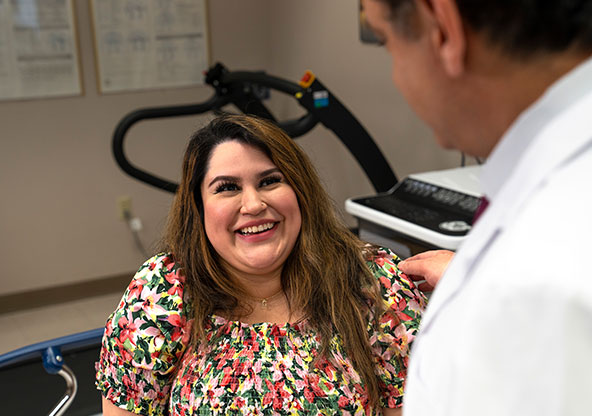
When Listening to Your Body Makes All the Difference
Crystal had just welcomed her daughter into the world when she sensed something was wrong.
Four days after delivery, the tightness in her chest hadn’t eased. Her legs were still swollen. Her breath felt shallow.
“I went home, and I still felt the same,” Crystal said. “I felt like I couldn’t breathe… and it just didn’t seem right.”
Even as a new mother focused on her baby, her body was telling her to pay attention.
“Especially with having a newborn… the last thing I was thinking about was me,” Crystal said. “But something just didn’t feel right.”
A Young Mother’s Symptoms Didn’t Fade, So She Spoke Up
Crystal went straight to the ICU and learned she had postpartum cardiomyopathy, a rare form of heart failure that can happen after delivery.
It was unusual in her case because she was young and otherwise healthy.
“Postpartum is the period after the delivery of the baby,” Dr. Mossaab Shuraih, an electrophysiologist at CHRISTUS Health, said. “And cardiomyopathy is a term we use to describe a weakening heart muscle… where the pumping function of the heart becomes weak.”
According to the National Heart, Lung, and Blood Institute, cardiomyopathy during pregnancy is serious but uncommon, affecting about 1 in 1,000 to 1 in 4,000 pregnancies in the United States. Postpartum cardiomyopathy can develop soon after delivery, and when it develops before, during, or within the 5 months after pregnancy, it’s known as peripartum cardiomyopathy.
Knowing the Signs After Pregnancy
Heart warning signs can appear during pregnancy or months after delivery. If something feels off, listen to your body and seek care.
Call your doctor or seek help right away if you notice:
- Trouble breathing that isn’t getting better.
- Extreme tiredness that feels abnormal or overwhelming.
- Swelling in your legs, ankles, or feet that’s getting worse.
- Fast or irregular heartbeat, dizziness, or chest discomfort.
“It was a huge reality check for sure,” Crystal said. “I have a new baby at home… a whole family that I need to get better for.”
Facing the Next Step in Her Recovery
Her team started medication and close follow-up to see if her heart would recover.
Her care team began treatment right away, using medications designed to help the heart regain strength and monitoring her closely over the next several months to see whether her heart function would improve. If it didn’t, they would need to consider longer-term protection, like an implantable cardioverter defibrillator, or ICD.
“Having the defibrillator is kind of like having a guardian angel over your heart,” Dr. Shuraih said. “We wish we never had to use it, but we do see it saving people’s lives.”
Crystal was shocked when Dr. Shuraih told her she would need a defibrillator because her heart could slip into a dangerous rhythm without warning.
“I was just like, 'why? Why are these the cards that I was dealt?' I’m young,” Crystal said. “But I know I have a lot left to live for, and I needed to take care of myself.”
Trusting Her Gut in the First Days of Motherhood
Because Crystal was young, her care team recommended a newer ICD placed outside the heart and vessels.
For younger patients, long-term implanted wires inside the veins can create problems over time, including infection, breaking, or narrowing of the vessels, so the team tries to protect the veins whenever possible.
“She was the first patient we were lucky to have… to provide this kind of treatment,” Dr. Shuraih said. "And if we were late a week, it could have been catastrophic.”
The procedure involved placing a small wire under the bone in the center of the chest and positioning the device along the side of the ribcage, near the underarm.
This setup allows the device to sense the heart’s electrical signals from outside the bloodstream, with the heart positioned between the generator and the wire for proper detection.
Being the first patient in South Texas to receive this device made Crystal nervous, but the support around her helped. Healing took time, and she stayed in touch with her team.
“Any concern that I had, it was quickly addressed,” Crystal said. “They took me seriously, and they listened.”
Moving Forward With Confidence
Crystal stays focused on what matters most to her, being present for her children and all the experiences still ahead of them.
Living with the device now gives her steady peace of mind. She feels a lot more confident about being able to do things.
“My kids… we still have the world to travel,” she said. “I need to be there for all of it.”
She hopes other women listen to the cues their bodies give them.
“Take it seriously. Listen to your body. Don’t brush it off,” she said. “If you have a concern, talk to your doctor… it truly could be something so big.”
Meet Crystal's Doctor
Take the Heart Risk Assessment
Check Your Risk of Heart Disease
Take our heart assessment to see if you are at risk of heart disease.
