
Young Athlete Finds Hope After a Serious Elbow Injury
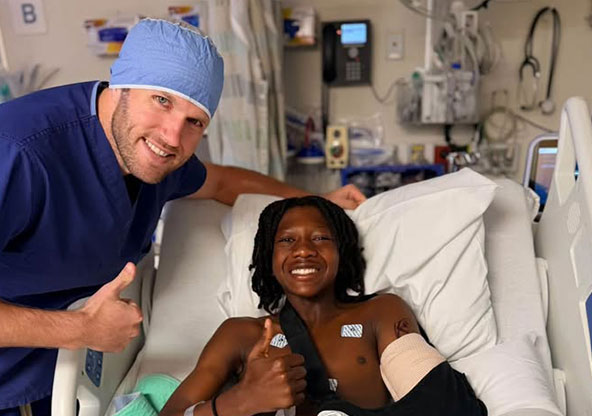
A Frightening Moment on the Football Field
Zavier's mother, Dominique Johnson, knew something was seriously wrong when her son did not get up after a hit on the football field. She heard Zavier scream in pain.
"I just had to pray," Dominique said.
For Zavier Johnson, playing sports is a major part of life. A football quarterback who also plays basketball and baseball, he now faces a different challenge: recovering from a serious elbow injury while navigating the uncertainty of what comes next.
An athletic trainer on the field suspected a dislocated elbow and stabilized his arm before he was taken to the emergency room. However, X-rays revealed something more serious: a broken elbow that required pediatric orthopedic surgery.
Zavier was transferred to CHRISTUS Health hospital in Longview, Good Shepherd for further care.
Specialized Orthopedic Surgery for a Complex Elbow Fracture
Zavier's family met with orthopedic surgeon Trevor Wait, MD, who practices at the CHRISTUS Orthopedics & Sports Medicine Institute in Longview. Dr. Wait determined that Zavier had a distal humerus fracture extending into his elbow joint.
"This is not common in his age group and is usually seen in more adult patients with higher energy, such as car accidents or falls from high levels," Dr. Wait explained.
Because the fracture extended into the elbow joint, Dr. Wait needed to restore proper alignment to protect Zavier's long-term mobility and function. He explained that a larger, more invasive repair was necessary to line up the injury accurately and support rehabilitation after surgery.
Dr. Wait explained that treating an injury like this involves more than operating as quickly as possible. After checking for emergency medical concerns, the team may take time to assemble the equipment and specialists needed for an appropriate repair.
The injury required a complex surgical repair. According to Dominique, Dr. Wait discovered that the damage was more extensive than initially anticipated. He repaired the fracture using a plate and screws to stabilize the injured bone.
For complex injuries such as a distal humerus fracture, specialized orthopedic surgery may be needed to restore alignment and support recovery.
Compassionate Care That Made a Difference
Beyond the surgical expertise, Dominique remembers the compassion her family received throughout Zavier's hospitalization.
"Dr. Wait was amazing," Dominique said, adding that he was the only person who could get Zavier to smile or engage in conversation during a difficult time.
She also praised the nursing staff for helping keep her son comfortable while he waited for surgery.
"The staff was amazing as well," Dominique said.
The Road to Recovery Is More Than Physical
Dr. Wait described an initial period of rest, including about a week of splinting, to let the arm settle after the injury and surgery. After that early rest period, the focus shifts toward movement to avoid stiffness.
Following surgery, Zavier began rehabilitation focused on restoring movement and strength in his injured arm. Dr. Wait emphasized that regaining range of motion is especially important after elbow surgery because the joint can become stiff during recovery.
Once the elbow shows adequate healing and range of motion is restored, rehabilitation progresses toward heavier strengthening for athletic activity. Injury and inactivity can cause substantial muscle loss, so rebuilding strength takes time and must happen gradually.
For Zavier, however, the challenges extend beyond physical recovery. Accustomed to playing football, basketball and baseball, he has struggled with the possibility that his injury could affect his athletic future.
Dominique has focused on encouraging her son and reminding him that this setback does not have to define what comes next.
"The rehab process is as much of a psychological rehab as it is a physical rehab," Dr. Wait said.
As Zavier continues recovering, his care team will monitor bone healing, range of motion and strength before determining when he can safely resume athletic activity.
For young athletes recovering from an orthopedic injury, a personalized youth sports injury recovery plan can help guide rehabilitation and a gradual return to physical activity.
A Message of Hope for Young Athletes and Their Families
For Dominique, the experience has reinforced the importance of patience, faith and emotional support when a child faces a serious injury.
Her advice to other parents is to acknowledge their child's emotions and provide encouragement throughout the recovery process.
"Make sure that they're seen and heard in their moment," she said.
Although Zavier's recovery journey is still underway, his story highlights the importance of specialized orthopedic care and the support that helps young athletes navigate an unexpected setback.
With encouragement from his family and guidance from his CHRISTUS care team, Zavier is taking recovery one step at a time, with hopes of returning to the sports he loves.
Orthopedic Care in Longview
Pediatric Orthopedic Care: Frequently Asked Questions
Parents and caregivers often have questions about orthopedic injuries, treatment and returning to sports. The answers below provide general information. A child’s care team can provide guidance based on the specific injury and recovery progress.
Children and teenagers are still growing, so orthopedic care must account for developing bones, joints and growth plates. A growth plate is an area of developing tissue near the end of a child’s bone. An injury involving this area may require careful evaluation because growth plates help determine the future length and shape of the bone.
The appropriate treatment depends on the child’s age, the type of injury and where the injury occurred.
A young athlete should be evaluated when an injury causes severe pain, significant swelling, an obvious change in the shape of a limb or joint, an inability to move the injured area or an inability to put weight on it. An evaluation may also be appropriate when pain continues after rest or repeatedly returns during sports or physical activity.
For a possible fracture, dislocation or other serious injury, seek prompt medical attention. Call 911 for a medical emergency.
Recovery after elbow surgery varies based on the type and severity of the injury, the procedure performed and how the child heals. Follow-up care may include a splint or cast, imaging, exercises or physical rehabilitation.
The orthopedic care team will monitor healing and provide guidance about returning to school activities, exercise and sports. Parents and caregivers should follow the recovery instructions provided for their child rather than relying on a general timeline.
A young athlete should not return to sports based on time alone. The orthopedic care team may consider bone healing, range of motion, strength, pain and the physical demands of the athlete’s sport.
Returning too soon could increase the risk of another injury. Families should follow the individualized return-to-play plan provided by the athlete’s care team.
Parents can look for an orthopedic professional with experience treating sports-related injuries and the specific type of injury their child has. It can also help to choose a care team that provides clear follow-up instructions, rehabilitation guidance and return-to-play recommendations.
Depending on the child’s age and condition, the appropriate professional may be a pediatric orthopedic specialist, an orthopedic surgeon or a sports medicine specialist.