
How Emergency Brain Tumor Surgery and Intensive Rehabilitation Gave David a Second Chance
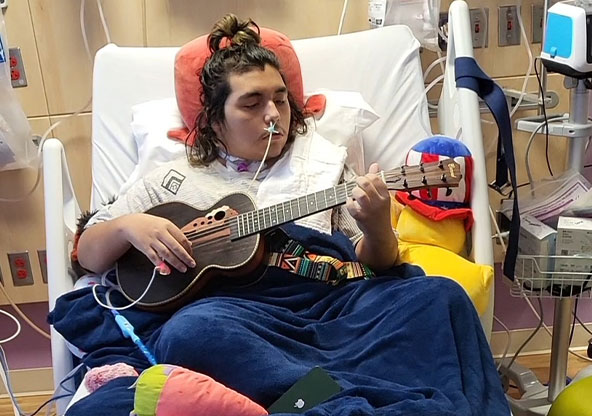
David Sanchez was a healthy high school junior with a full life ahead of him. He lifted weights, took advanced classes and proudly performed music in both varsity mariachi and his band, Seaglass. His family believed he would be the first among his cousins to attend college.
David, who turned 17 in April 2026, lives with his grandmother, Cindy Guerra, 66, in San Antonio. “Ma,” as David calls her, has raised him since he was 9 years old. While he maintains a relationship with his parents, Cindy provided the stability he needed.
“He’s one of the smartest kids I know,” Cindy said. “He used to be involved in so many activities and was always able to keep his grades up. I’ve been proud of him every day of his life.”
When David complained of a headache in early January 2026, Cindy initially thought he might have strained his neck from playing the drums.
“He could really get into drum playing,” Cindy said with a laugh. “But he thought he might be getting sick. The headache seemed very odd to him. He even said he wanted to keep his distance from me because he didn’t want me to catch whatever he had.”
Two nights after playing a gig, David woke up feeling worse and asked to go to the local emergency room.
That request immediately alarmed Cindy.
“He hardly gets sick,” she said. “I’ve learned that parents need to teach their children to trust their instincts, and we need to trust them when they tell us something doesn’t feel right.”
David’s cousin, Cybele Sanchez, accompanied him to the ER while Cindy waited anxiously at home for updates.
The text never came from David.
Instead, Cybele called with devastating news. Doctors had discovered a tumor roughly the size of a lemon pressing against David’s brain stem.
Emergency Brain Surgery at CHRISTUS Children’s
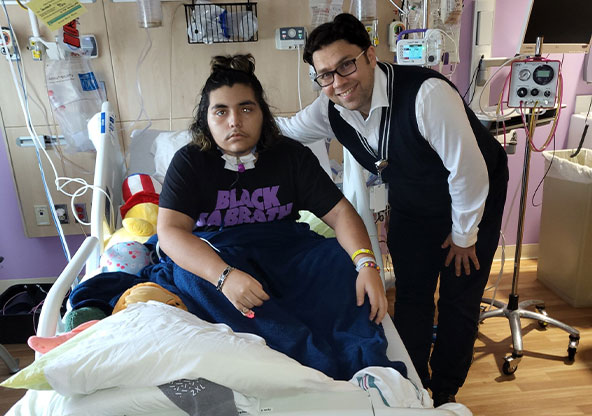
The local hospital was not equipped to manage David’s condition, and he was transported by ambulance to CHRISTUS Children’s for specialized pediatric neurosurgical care.
By the time Cindy arrived, there was no time to lose. She was asked to sign paperwork while David was being prepared for emergency brain surgery to remove the tumor.
Dr. Bassel Bali, pediatric neurosurgeon at CHRISTUS Children’s, explained the urgency to the family before surgery.
“He was very clear about what needed to happen. He told us if David didn’t have surgery, the outcome could be catastrophic,” Cindy said. “He was compassionate and thorough. I was so impressed by how he answered all our questions and somehow managed to keep us calm, even though the situation felt overwhelming.”
Dr. Bali said imaging revealed a tumor in the back of David’s brain that was blocking the normal flow of cerebrospinal fluid, causing a dangerous buildup of pressure known as hydrocephalus. The tumor was also compressing the brain stem, the part of the brain that controls essential functions such as breathing, heart rate and consciousness.
“When a tumor in this location compresses the brain stem and obstructs the normal flow of cerebrospinal fluid, it creates a life-threatening emergency,” Dr. Bali said. “Without urgent treatment, the increasing pressure on the brain can rapidly become fatal. Removing tumors in this area is especially challenging because they are surrounded by critical nerves and blood vessels that control many of the body’s most vital functions.”
After an eight-hour surgery, Dr. Bali told the family he had removed nearly all of the tumor.
“We were relieved when Dr. Bali told us he expected David to breathe on his own once the ventilator was removed,” Cindy said. “But when they tried, his lungs collapsed.”
David remained on the ventilator for several days while his care team closely monitored his condition in the pediatric intensive care unit (PICU).
During that time, physicians prepared to place him on extracorporeal membrane oxygenation (ECMO), a form of life support that temporarily takes over the function of the heart and lungs, because his oxygen levels had dropped to dangerously low levels, sometimes into the 60s.
Cindy had already signed the paperwork authorizing ECMO.
Pediatric Intensive Care
Explore Pediatric Critical Care
When a child faces a serious illness, injury or recovery after surgery, specialized critical care can make all the difference. Learn how pediatric intensive care teams provide around-the-clock monitoring, advanced treatments and compassionate support for children and their families.
Rare PRES Diagnosis Following Brain Surgery
Then, suddenly, David’s oxygen levels began to improve.
“They were preparing for ECMO and suddenly his oxygen went up to 95,” Cindy said. “I felt like it was divine intervention. I had people praying for him all over the world.”
But David’s recovery remained extremely complex.
He required a tracheostomy — a surgically placed tube in the neck that helps keep the airway open — and remained in the PICU at CHRISTUS Children's for five weeks before eventually transferring to the surgical floor.
About two weeks after surgery, David developed a severe fever reaching 106 degrees. Despite extensive testing and involvement from infectious disease specialists at CHRISTUS Children's, doctors initially could not determine the cause.
“The fever triggered three febrile seizures,” Cindy recalled. “He was unresponsive for weeks until we finally got a rare diagnosis.”
David was diagnosed with posterior reversible encephalopathy syndrome (PRES), a rare neurological condition that can occur after major brain surgery and is associated with swelling in the brain and dangerously high blood pressure.
Once PRES was identified, physicians quickly adjusted David’s medications to better control his blood pressure.
Cindy describes what happened next as “nothing short of a miracle.”
“Three days after they started treating the PRES, David squeezed my hands,” she said. “That was the moment I knew he was still with us.”
Gradually, David became more alert. By the time he transferred out of intensive care, he was communicating through a whiteboard and text messages.
Because of the tracheostomy, David was unable to speak, and damage caused by the tumor left him unable to move his facial muscles. He also could not swallow, so he received liquid nutrition through a gastrostomy tube (G-tube) placed directly into his stomach.
Intensive Rehabilitation Helps David Regain Strength and Independence
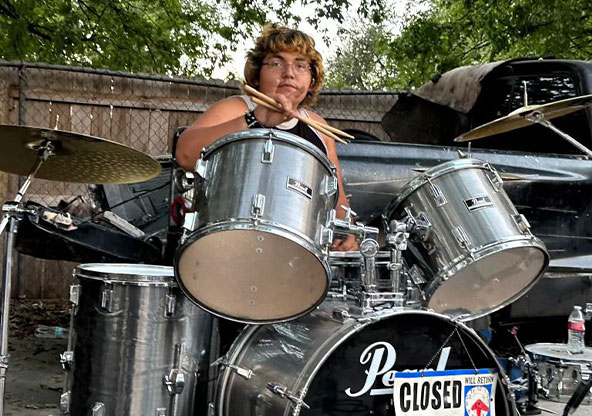
David underwent intensive rehabilitation at CHRISTUS Children’s, receiving physical, occupational and speech therapy several times a week. His care team worked closely with him to improve his mobility, strength, communication and swallowing skills as he recovered.
While he still struggles with double vision and muscle weakness, his determination remains strong.
“He texts his doctors questions all the time, and they answer every one in detail,” Cindy said. “It’s a great sign that he wants to understand everything that’s happening and is focused on getting better.”
As David continued his rehabilitation, he also underwent additional treatment to reduce the risk of the tumor returning.
David was diagnosed with a grade 2 ependymoma, a tumor with malignant potential. Dr. Bali was able to remove most of the tumor during surgery, but a repeat surgery to remove the remaining tumor was considered too risky. Because David had a subtotal surgical resection, radiation therapy was the standard next step in his treatment.
David underwent a five-week radiation regimen consisting of 33 treatments.
Throughout David’s radiation treatment, Dr. Ricky Rodriguez, an oncologist at CHRISTUS Children’s, helped guide the family and answered their many questions along the way. According to Dr. Rodriguez, David’s tumor subtype has a very favorable prognosis and is less likely to recur, but he will require ongoing surveillance with physical exams and MRI imaging.
“He explained everything so clearly,” Cindy said. “He is very caring. In fact, all the nurses and therapists who cared for David, especially during his most critical days, have been phenomenal.”
After a lengthy hospitalization, David was discharged home on April 30, 2026. Just one week later, he completed all 33 of his radiation treatments and was presented with a certificate of completion, a milestone that marked the end of another major chapter in his recovery.
Today, David continues to make steady progress. While he still has a tracheostomy, his pulmonologist and ENT specialist are discussing decannulation — the removal of the trach tube — in the near future. He is awaiting a trach cap and will undergo a sleep study, both important steps toward breathing independently.
David also continues to work on speech and swallowing through therapy at CHRISTUS Children's Rehabilitation. While he still receives most of his nutrition through a G-tube, his speech has become more articulate, and he is gradually relearning how to swallow safely.
The progress, though gradual, has been encouraging. Recently, David ate five chicken nuggets on his own and drank a chilled 12-ounce Coca-Cola with the help of a syringe — milestones his family celebrated as signs of continued recovery.
Family Praises Multidisciplinary Care at CHRISTUS Children’s
Although David has made significant progress in rehabilitation, he remembers very little about the weeks following surgery. He recalls the headache and the ambulance ride, but little else.
Now, David’s family is focused on the future and hopeful he will continue regaining his strength, speech and ability to breathe independently once the tracheostomy is removed.
“He tells me physically he feels stronger because of therapy,” Cindy said. “But mentally, I know he is scared. He often sends me texts about wanting to live.”
Her response never changes.
“You are going to live,” she tells him. “We are at CHRISTUS Children’s. Your doctors are doing everything they possibly can to help you get better, and everyone is praying. You’ve already come so far, and we’re going to keep taking this one day at a time.”
Continue exploring our CHRISTUS Children's Neuroscience Center and pediatric neurology services to learn more.
