
Kaylee’s Rhabdomyosarcoma Journey: Childhood Cancer Treatment and Survivorship
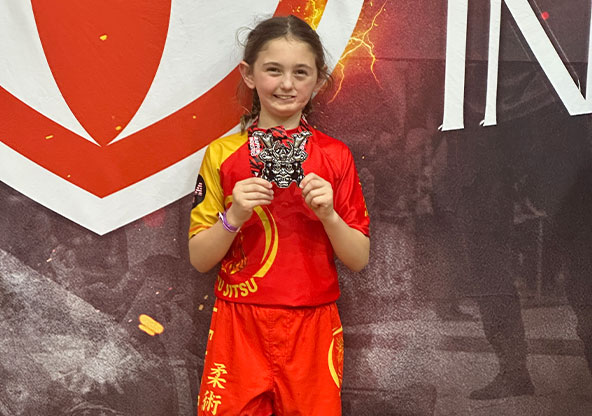
At 9 years old, Kaylee rarely slows down. She swims, practices jiu-jitsu and performs aerial gymnastics. She eagerly rides the biggest roller coaster she can find and loves making people laugh. Her mother, Melissa, describes her as deeply empathetic, with one of the biggest hearts of anyone she has ever known.
Kaylee’s joyful, adventurous life today reflects just how far she has come. Diagnosed with alveolar rhabdomyosarcoma at only 18 months old, she underwent intensive treatment for an aggressive childhood cancer affecting the left side of her face. Her care has continued through years of follow-up and reconstructive surgeries.
Today, Kaylee has been in remission for six years. She’s my miracle child.
With support from the pediatric cancer team at CHRISTUS Children’s, Kaylee and her family worked to understand the diagnosis, navigate her care and face each new stage together.
A Spot on Kaylee’s Cheek Led to a Rhabdomyosarcoma Diagnosis
Kaylee had recently started daycare when she fell and developed bruises under her chin and along her cheek. While the bruising faded within about a week, one small area remained. Beneath the skin of her cheek was a faint blue spot that initially looked like a visible vein but gradually became firm.
Because it was unclear whether the lump originated inside Kaylee’s mouth or within her cheek, one possible explanation was a mucocele, a usually harmless pocket of mucus caused by a blocked or injured salivary duct. After a pediatric dentist suggested that was likely the cause, another recognized that the growth did not look like a typical mucocele and recommended further evaluation. An oral surgeon then removed a portion of the growth for a biopsy.
The next day, Melissa and her husband, Zachary, received the results that no parent expects: The biopsy had identified rhabdomyosarcoma.
I just went into shock. I remember looking at my husband and thinking, ‘What is rhabdomyosarcoma?’
Kaylee’s primary care provider arranged an appointment for the following day with Dr. Nadia Cheek, a pediatric hematologist-oncologist and director of the Survivorship Program at CHRISTUS Children’s.
Rhabdomyosarcoma is a rare and aggressive cancer that develops as a growth of cells in soft tissue, most commonly arising from muscle tissue. It can grow quickly and, without effective treatment, can become life-threatening. Treatment may combine chemotherapy, surgery and radiation therapy based on the tumor’s location, subtype and whether it has spread.
Testing showed that Kaylee had the alveolar subtype of rhabdomyosarcoma, a rarer form of the disease that often requires aggressive treatment. As Melissa learned more about what the diagnosis meant, she realized her daughter’s journey would be more complex than a single surgery or short course of therapy.
Dr. Cheek answered the family’s questions directly, explaining Kaylee’s cancer subtype, the testing used to identify it, the recommended chemotherapy protocol and what they could expect in the months ahead. She also helped them understand that treating an aggressive cancer in such a delicate area would require close coordination among pediatric oncology, surgery, radiation therapy and other specialties.
She was very straightforward and honest from the start, which we really appreciated. She took the time to explain everything so we could actually understand what was happening, even though we were scared.
Rhabdomyosarcoma Treatment: Chemotherapy, Surgery and Radiation
Kaylee’s initial biopsy provided the diagnosis, but it was only the beginning of determining how extensively the cancer involved her cheek and how it could be treated while preserving as much facial movement and function as possible. The mass was located near the corner of her mouth, where nerves and muscles control facial expression, speech and other important functions.
Dr. Cheek collaborated with Dr. Taylor Fordham Jr., a pediatric otolaryngologist at CHRISTUS Children’s and assistant professor at Baylor College of Medicine, to further evaluate the tumor and plan the next steps in Kaylee’s care.
When Dr. Fordham examined Kaylee, he could still feel significant firmness inside her cheek. After discussing her case with the hospital’s tumor board, he performed an additional procedure using small incisions inside her mouth to collect tissue from the tumor site and surrounding margins. Pathology confirmed that cancer remained.
Because of the tumor’s location near the corner of Kaylee’s mouth, the care team also had to consider how aggressive surgery could affect both her appearance and her ability to use her mouth normally.
The primary concern is oral competence,
Dr. Fordham said. If you have to remove the corner of the mouth, a child may not be able to fully close their mouth and retain saliva and other contents. There’s the cosmetic element to it as well, especially for a child, but preserving that function was a major focus. That’s why a thoughtful, collaborative approach is so important in a case like Kaylee’s.
Imaging also showed a significantly enlarged lymph node on the left side of Kaylee’s neck, the same side as the tumor. The node measured approximately 2.5 to 3 centimeters, making it particularly concerning in a child with a known cancer and raising significant concern that the disease had spread. Because tumors in the mouth can spread through predictable lymph node regions in the neck, Dr. Fordham removed lymph nodes from the areas considered at risk. Pathologists examined approximately 50 to 60 lymph nodes, and all were negative for cancer.
The results were especially significant for Kaylee’s treatment plan. Because the cancer had not spread to her lymph nodes, her neck could be spared a treatment dose of radiation, limiting additional radiation exposure at such a young age.
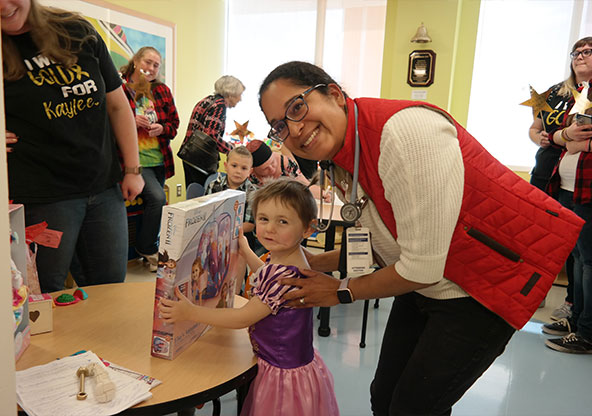
Kaylee began chemotherapy within days of her diagnosis to treat the known tumor and any microscopic cancer cells that could not be seen on scans. She received her first treatment as an inpatient at CHRISTUS Children’s, where Melissa remembers her 18-month-old sometimes falling asleep during long treatments, blood draws and monitoring.
After several months of chemotherapy, surgery became the next critical step. Dr. Fordham reached out directly to pediatric surgical specialists at Texas Children’s, helping connect the family with a multidisciplinary team for the next phase of Kaylee’s care. Although portions of Kaylee’s care took place at other institutions, the CHRISTUS Children’s team remained closely involved, collaborating and coordinating her chemotherapy and helping the family understand how each part of the treatment plan worked together.
Scar tissue from Kaylee’s earlier procedures made it difficult for surgeons to fully evaluate the surrounding tissue during the operation. When the pathology results came back, they showed that treated cancer cells were still present near her upper and lower lips. To give Kaylee the best chance of preventing the cancer from returning, the care team recommended removing additional tissue.
After discussing what would be required to reduce the risk of the cancer returning, the family and care team made the difficult decision to proceed with a second operation. Surgeons removed additional tissue, including part of the left side of Kaylee’s lips and a significant portion of her cheek.
The surgery changed the appearance and movement of the left side of Kaylee’s mouth, but it also gave her the best opportunity to remove the remaining cancer as completely as possible. From that point forward, reconstruction became an important part of helping her recover both function and facial development.
Radiation therapy was the next component of Kaylee’s treatment, targeting microscopic cancer cells that may have remained around the original tumor site.
Because Kaylee’s tumor developed near her mouth, jaw and other growing facial structures, minimizing radiation exposure to nearby healthy tissue was especially important. The CHRISTUS Children’s team connected the family with MD Anderson for proton radiation therapy and continued coordinating with the specialists involved in her care. This approach allowed the radiation to be directed more precisely at the tumor area, helping limit exposure to Kaylee’s developing brain, facial bones, teeth and other healthy structures. Social workers also helped the family arrange lodging and other support during months filled with chemotherapy, operations, hospital stays, travel and radiation appointments.
After completing radiation, Kaylee returned to CHRISTUS Children’s to finish chemotherapy and begin the next phase of follow-up care with Dr. Cheek.
Dr. Cheek was our constant,
Melissa said. She was always there to answer questions and help us understand what came next.
Treatment eventually ended, although confidence that the cancer would not return came gradually with each clear scan and follow-up appointment.
Related Content
Cancer and blood disorders
Find pediatric cancer care
A childhood cancer or blood disorder diagnosis brings questions for the whole family. Find specialized, compassionate care at CHRISTUS Children’s in San Antonio, with treatment plans tailored to your child and support from diagnosis through survivorship. Explore services, treatment options and family resources designed to guide every step.
Rhabdomyosarcoma Survivorship and Long-Term Follow-Up Care
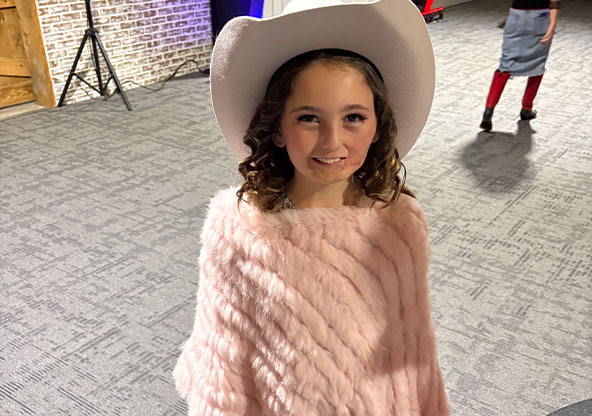
Six years after completing treatment, Kaylee is thriving. But for children who survive a rare and aggressive cancer like alveolar rhabdomyosarcoma, remission is not the end of their medical journey.
Kaylee returns to CHRISTUS Children’s for annual survivorship appointments, where Dr. Cheek and her care team monitor for signs of recurrence, track her growth and development and watch for long-term effects of treatment. She also continues seeing ear, nose and throat specialists, reconstructive surgeons, endocrinology, ophthalmology, audiologists and dental providers as her needs change with age.
Radiation therapy played an essential role in controlling Kaylee’s cancer, but treatment near the face can continue affecting a child long after therapy ends. Because the bones and soft tissues on the treated side of her face do not grow at the same rate as those on the other side, differences can become more noticeable as she gets older. Radiation also affected the development of her adult teeth, causing some to form abnormally while others are missing.
Kaylee’s reconstructive care has focused on both facial growth and movement. During some procedures, surgeons have transferred fat, skin or other tissue from another part of her body to restore volume in her cheek and address changes related to growth. Other operations have worked to rebuild movement after the original cancer surgery required the removal of tissue and nerves controlling the left side of her mouth.
In one staged approach, surgeons used a nerve graft from Kaylee’s leg to create a new pathway for movement signals between the functioning and affected sides of her face. During a later procedure, they transferred a small piece of muscle into her cheek and connected it to that pathway, with the goal of restoring movement at the corner of her mouth.
More reconstruction and dental treatment may be needed as Kaylee grows. She sees her reconstructive team about every four months and has generally undergone one facial procedure each year. Although she was too young to understand many of the earliest decisions, she has become increasingly involved in her own care. She now asks questions, knows when an appointment will involve lab work and participates in decisions about what will happen to her body.
Melissa encourages parents beginning a childhood cancer journey to ask questions, accept help and use the support available through their child’s care team, especially social workers. Parents don’t have to be superheroes. It’s okay to lean on the people around you. You don’t have to carry the weight alone.
Online groups also connected Melissa with families across the country and around the world whose children had rhabdomyosarcoma. Years ago, she was the parent searching for information about a rare, aggressive cancer and wondering what her daughter’s future might look like.
When another family comes across Kaylee’s story, Melissa hopes they find reassurance in seeing a healthy, cancer-free 9-year-old who makes the most of every day. She wants families whose children have just been diagnosed with rhabdomyosarcoma to see that even after a rare and aggressive cancer, there can be hope.
If your child has been diagnosed with rhabdomyosarcoma or another type of cancer, the pediatric hematology and oncology team at CHRISTUS Children’s provides compassionate care from diagnosis and treatment through survivorship.
